
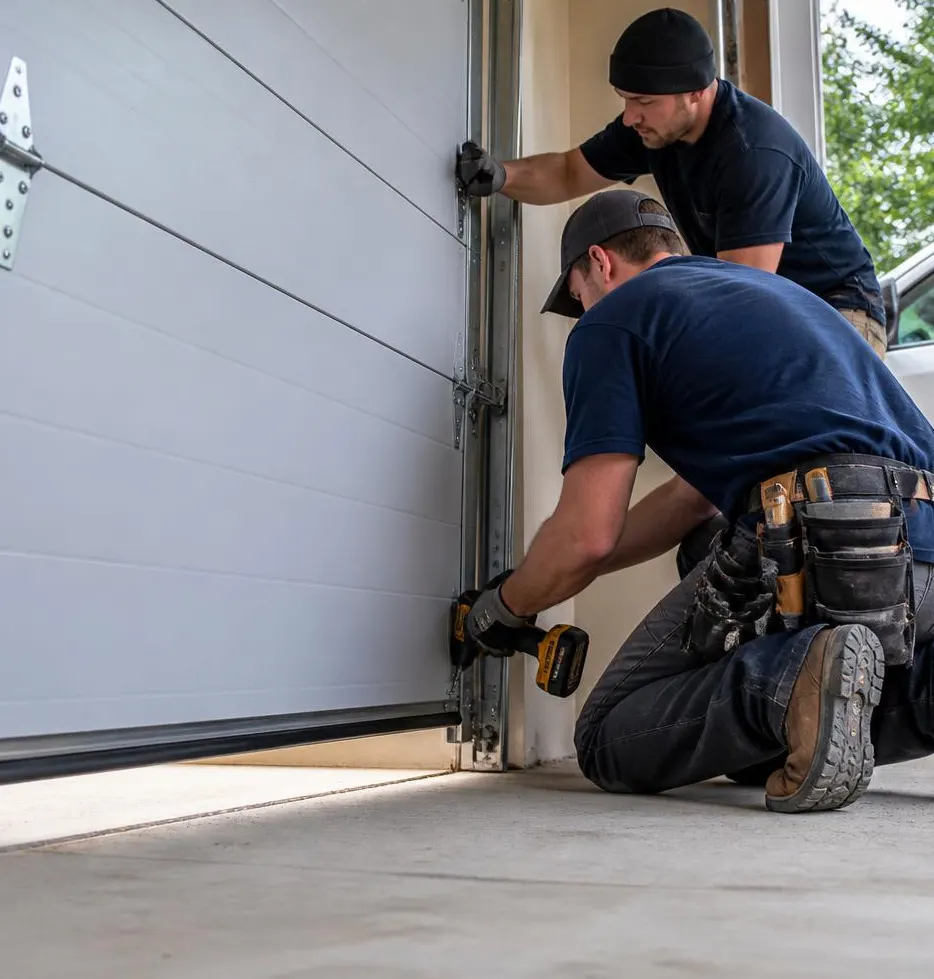
You hit the opener button on your way out and nothing happens — or the door groans up two inches, stutters, and stalls. Maybe it opens fine but closes like it's dragging something behind it. The first cold snap of the season in the Inland Empire tends to expose this all at once, usually on a morning after overnight rain or heavy dew, when the garage has sat cold and damp since the night before.
San Bernardino doesn't get hard freezes often, but low inland valleys and foothill-adjacent neighborhoods do see temperatures drop into the 30s overnight in late fall and winter, especially after a rain system moves through. That's enough to stiffen lubricant, swell wood framing, and leave moisture sitting on metal parts that spent the summer bone dry. None of this is as dramatic as a door frozen solid in a snowbelt garage, but it produces the same symptoms: a door that's sluggish, noisy, or outright stuck.
What You'll Notice
- The door won't lift at all when you press the opener, and the motor hums or strains without movement.
- It opens partway and stops, sometimes reversing back down on its own.
- A loud pop or crack right as the door breaks free from the floor, especially on the first use of the day.
- Grinding or squealing from the tracks or rollers that wasn't there a month ago.
- The remote works inconsistently, needing several presses before the door responds.
Any one of these on its own might be minor. Several together, especially right after a cold or rainy stretch, usually point to the same handful of causes — and they're worth checking in the order a technician actually would.
Causes, Checked in Order
1. The Bottom Seal Stuck to the Slab
This is the first thing to rule out because it's the most common and the easiest to fix. Rubber weatherstripping along the bottom of the door can bond lightly to a damp concrete floor overnight, especially on garages with a slight slope or a slab that holds moisture. The door isn't actually jammed — it's just glued down by surface tension and cold rubber.
The fix: A technician will inspect the seal for cracking or flattening and may simply free it, clean the slab contact strip, and apply a food-grade silicone lubricant to the gasket so it releases cleanly next time. If the seal is cracked or compressed flat, replacing it is a low-cost fix that also helps with drafts and dust intrusion during Santa Ana wind events later in the year.
2. Lubricant That's Too Thick or Too Dirty
Lubricant that worked fine in 100-degree summer heat can turn gummy once temperatures drop, especially if it's old, dust-laden grease rather than a proper garage door lubricant. Combined with fine dust that settles into tracks and hinges during the dry season, this creates real drag on rollers and hinges.
The fix: Tracks, rollers, hinges, and the torsion shaft get wiped clean of old grease and grit, then relubricated with a silicone or lithium-based spray made for garage doors — never household oil, which attracts more dust.
3. Torsion Springs Under Temperature Stress
Metal contracts slightly in the cold, which can make an already-worn spring feel noticeably stiffer or cause uneven tension between two springs on a double-spring setup. This is also when a spring nearing the end of its life is most likely to show its age — through slower movement, a door that feels heavier than usual, or a sharp bang as it finally gives way.
The fix: A technician checks spring tension and wear visually and by how the door balances when manually released from the opener. A worn or mismatched spring gets replaced as a set, never one side alone, since uneven tension strains the opener and the new spring.
4. Track Alignment and Roller Binding
Garages built on older slabs, common throughout San Bernardino's established neighborhoods, sometimes shift slightly with seasonal moisture changes. Combined with metal contraction, this can leave tracks a hair out of alignment, enough to bind rollers that were running smoothly all summer.
The fix: Tracks get checked with a level, bolts tightened, and rollers inspected for flat spots or wear that make binding worse in cold weather.
5. Opener Sensors and Limit Settings
Cold, damp mornings can fog or mist the photo-eye sensors near the floor, causing the opener to stop or reverse the door as a false safety response. Limit switches that were set during warmer months can also drift slightly as components contract.
The fix: Sensors get wiped down and realigned, and limit settings are recalibrated so the door opens and closes fully without the opener fighting itself.
When to Call San Bernardino Garage Door Service
If the door pops free each morning but still seems slow or noisy, that's worth a maintenance visit before it turns into a stuck spring or a stripped opener gear. If it won't move at all, reverses unexpectedly, or you hear a bang followed by the door going dead, stop using it and call. Our Garage Door Maintenance service covers the lubrication, alignment, and sensor checks above in one visit, and our Spring Replacement service handles the heavier fix safely if a spring has given out. For a door that's stuck shut with no warning, our Emergency Garage Door Service gets a technician out the same day.
If your garage door is dragging its feet this season, call San Bernardino Garage Door Service for a fast, honest diagnosis — we serve San Bernardino, CA and the surrounding Inland Empire, rain or shine.