
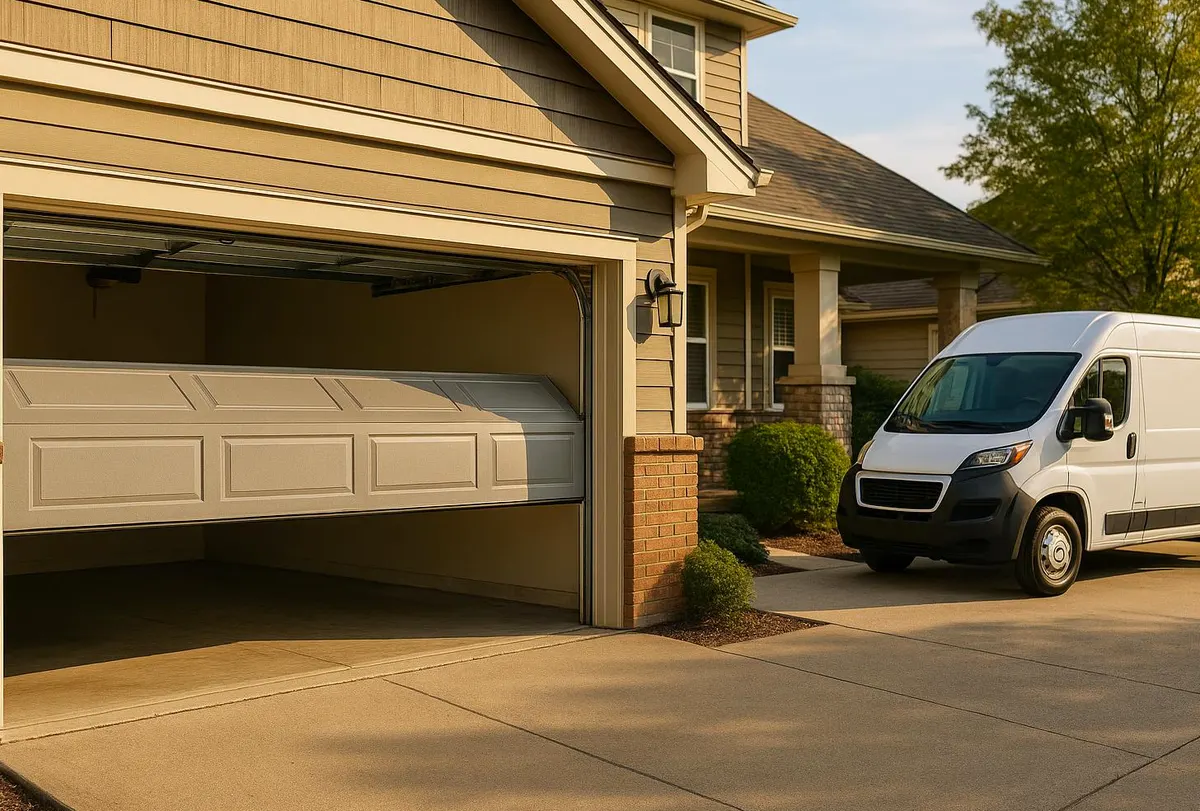
Another Season of Putting It Off
If your garage door has felt heavier lately, or it slams the last foot instead of lowering smoothly, that's usually a spring losing tension. Most people notice this, decide it's not urgent, and keep opening the door by hand for a few more weeks. Then winter rain arrives, the metal contracts and expands with temperature swings, and a spring that was barely holding on finally lets go. At that point you're not dealing with a minor repair anymore. You're dealing with a door that won't open at all, or worse, a spring that snapped while someone was standing underneath the opener or reaching up to grab the release cord.
Garage door springs are one of the most dangerous components in an average home, and almost nobody treats them that way until something goes wrong.
Why This Specific Repair Is So Risky
A standard torsion spring is wound to hold several hundred pounds of tension, coiled tight around a shaft above the door. That tension is what lets a 150-plus pound door feel light enough to lift by hand. When a spring is intact and properly wound, the tension is contained. When it's being installed, adjusted, or removed, that tension has nowhere controlled to go unless you're using the right tools and the right sequence.
Here's what actually happens when it goes wrong:
- The winding bars slip. Torsion springs are wound using steel winding bars inserted into the winding cone. If a bar slips out mid-wind, or if someone uses a screwdriver or makeshift tool instead of the correct bar, the spring can unwind violently in a fraction of a second, whipping the bar around with enough force to break fingers, hands, or facial bones.
- The spring snaps under load. A spring that's rusted, fatigued, or already cracked can fail the moment it's touched. Inland heat and dust cycles followed by winter moisture accelerate corrosion on springs that aren't maintained, so a spring that looks fine from a few feet away may already be compromised.
- The door falls. If someone disconnects or removes a spring without first securing the door, there's nothing left holding that weight. A falling garage door has caused crushed hands, broken feet, and serious injury to anyone standing in the opening.
- The wrong spring is installed. Torsion springs are rated by wire size, coil diameter, and length, all matched to the specific weight and height of your door. A mismatched spring either fails quickly or overcorrects, putting uneven strain on the shaft, cables, and bearing plates.
None of this is theoretical. Emergency rooms see garage door spring injuries every year, and they're rarely minor. These are high-energy mechanical failures, not a stripped screw or a loose hinge.
What Actually Prevents This
You don't need to become a technician to avoid the dangerous version of this problem. You need to recognize the warning signs early and know where the line is between homeowner maintenance and a job that requires training and the right equipment.
- Watch for the early symptoms. A door that feels unusually heavy, drifts open or closed on its own, or makes a loud bang followed by the door sticking in place are all signs of spring failure in progress. Address it at this stage, not after the spring fully breaks.
- Never remove the winding cones yourself. If you don't own a matched pair of properly sized winding bars and haven't been trained to use them, this step alone accounts for most serious injuries. There is no safe shortcut.
- Don't rely on the opener to hold the door. Garage door openers are not designed to bear the full weight of a door with a broken spring. Forcing the opener to do this can damage the unit and still leaves the door unsupported if something else gives way.
- Check springs seasonally, don't touch them. Visual inspection for rust, gaps in the coil, or visible stretching is fine. Adjustment, tensioning, and replacement are not DIY tasks regardless of how many tutorials make it look simple.
- Replace in pairs when one side fails. If one torsion spring breaks, the other is usually close behind, especially if they were installed at the same time. Replacing only one creates uneven tension and shortens the life of the new spring.
When to Call San Bernardino Garage Door Service
If your door is heavy, uneven, slamming, or you've heard a loud pop followed by the door refusing to move, that's a spring problem, and it's time to call. Our technicians handle Spring Replacement using properly matched torsion springs rated for your door's exact weight and size, along with the correct winding tools to install them safely. We also offer Emergency Garage Door Service for situations where a spring has already failed and the door is stuck open, stuck closed, or unsafe to operate. We'll secure the door, replace what's needed, and check the opener and cables for any related strain before we leave.
If something feels off with your garage door, don't wait for the bang. Call San Bernardino Garage Door Service and get it looked at before it becomes an emergency room visit instead of a service call.